Research
My current research sits at the intersection of AI, management, and decision sciences. I pursue two complementary streams, united by a broader agenda: building computationally rigorous, decision-relevant, and scientifically grounded tools in Human + AI + Decision Science.
Research Stream 1: Decision-Aware Learning. I study how firms can design learning systems that optimize not only predictive accuracy, but also the quality of the downstream decisions they support.
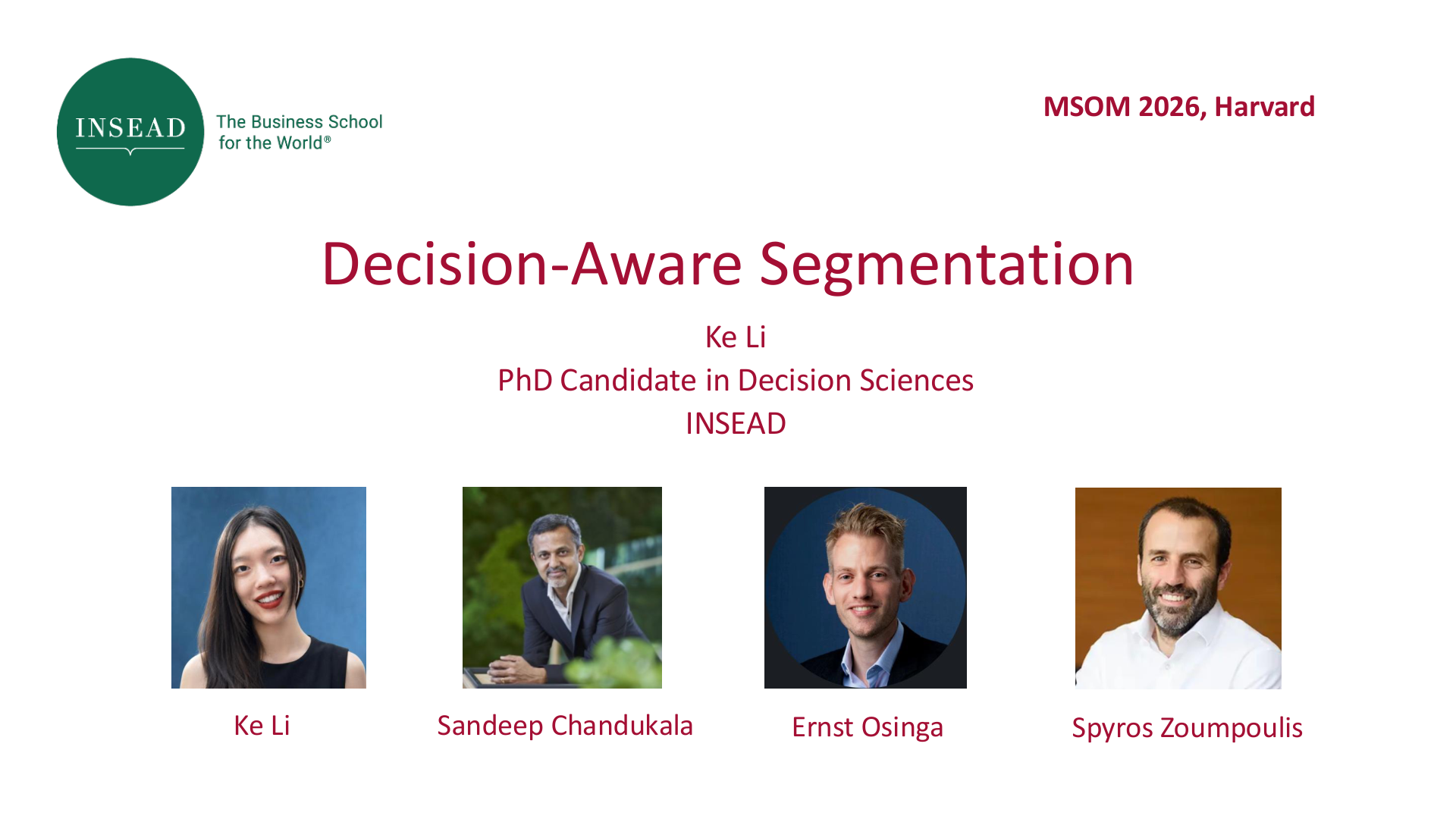
Decision-Aware Segmentation
Working Paper
Abstract
Customer segmentation is everywhere in marketing. However, widely used segmentation methods are descriptive rather than prescriptive: they partition customers by optimizing statistical criteria (e.g., minimizing within-cluster distances), without regard to the firm’s downstream targeting objective. As a result, segments that are statistically well-formed may induce suboptimal targeting policies. This paper asks a fundamental question: if the goal of segmentation is to decide who should receive which action, can we learn the segments with that decision in mind? We develop Decision-Aware Segmentation (DAS), a framework that learns customer segments by optimizing the value of the targeting policies they induce. More broadly, the paper positions segmentation as part of the decision problem itself, offering a middle ground between traditional descriptive clustering and fully individualized targeting.
Research Stream 2: Human–AI Collaboration in Science. I study how human researchers and AI systems can collaborate productively in the broader scientific process.
AI Theory Building
Working Paper
Abstract
Generative AI is rapidly moving into tasks near the intellectual core of science. This project asks: what are the comparative advantages of generative AI and human scientists in scientific theory building? We compare humans and AI as they formulate theories, predict previously unseen empirical patterns, and revise their theories in response to new evidence. We found that generative AI performs as well as, and often better than, the average human scientist across several theory-building tasks, particularly when reasoning about complex interaction effects. Its theories are also more elaborate, although this added complexity does not necessarily produce more accurate predictions. Human scientists, by contrast, generate a much wider range of ideas, and this diversity produces larger gains when their judgments are aggregated. AI systems are also more likely to revise their theories in response to new evidence, while humans update more selectively. These findings suggest a future of scientific discovery in which AI contributes scale and complexity, while humans remain an important source of intellectual diversity and collective intelligence.
Publications
See Google Scholar for recent updates.
-
Learning from Visual Observation via Offline Pretrained State-to-Go Transformer · Paper · Website · Code
Bohan Zhou, Ke Li, Jiechuan Jiang, and Zongqing Lu.
Advances in Neural Information Processing Systems (NeurIPS), 2023. -
Combinatorial Bandits under Strategic Manipulations · Paper
Jing Dong, Ke Li, Shuai Li, and Baoxiang Wang.
ACM International Conference on Web Search and Data Mining (WSDM), 2022. -
EduChain: A Blockchain-Based Education Data Management System
Yihan Liu, Ke Li, Zihao Huang, Bowen Li, Guiyan Wang, and Wei Cai.
CCF China Blockchain Conference (CBCC), 2020.